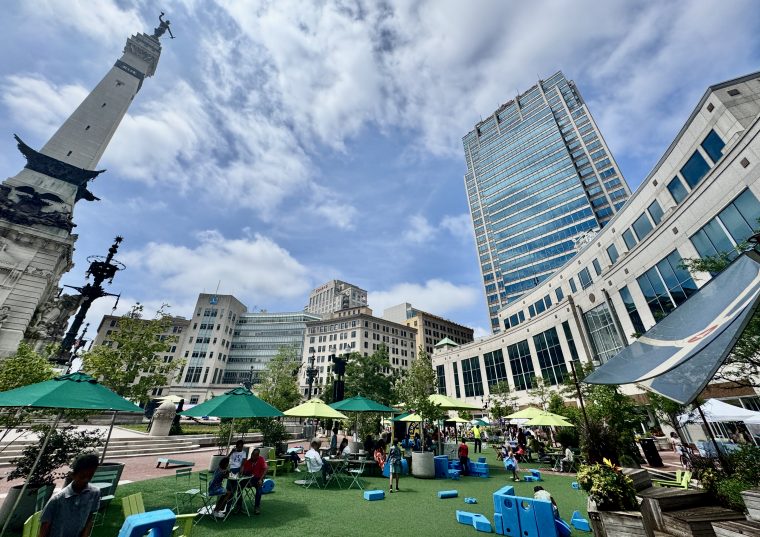
When SPARK first appeared on Monument Circle in downtown Indianapolis in 2015, it may have been easy to mistake for a summer program of casual activities. Look a little past the first impression and you’ll see SPARK is not a backdrop to life in the Circle, it is art unfolding through play, encounter, and exchange.
A Curated Social Practice
SPARK is curated and authored by Big Car Collaborative, the Indianapolis arts organization long recognised for its leadership in socially engaged art and placemaking. SPARK — an ongoing partnership with the City of Indianapolis and the Downtown Indy Alliance — is not merely incidental sociability, nor public entertainment. It’s much more.
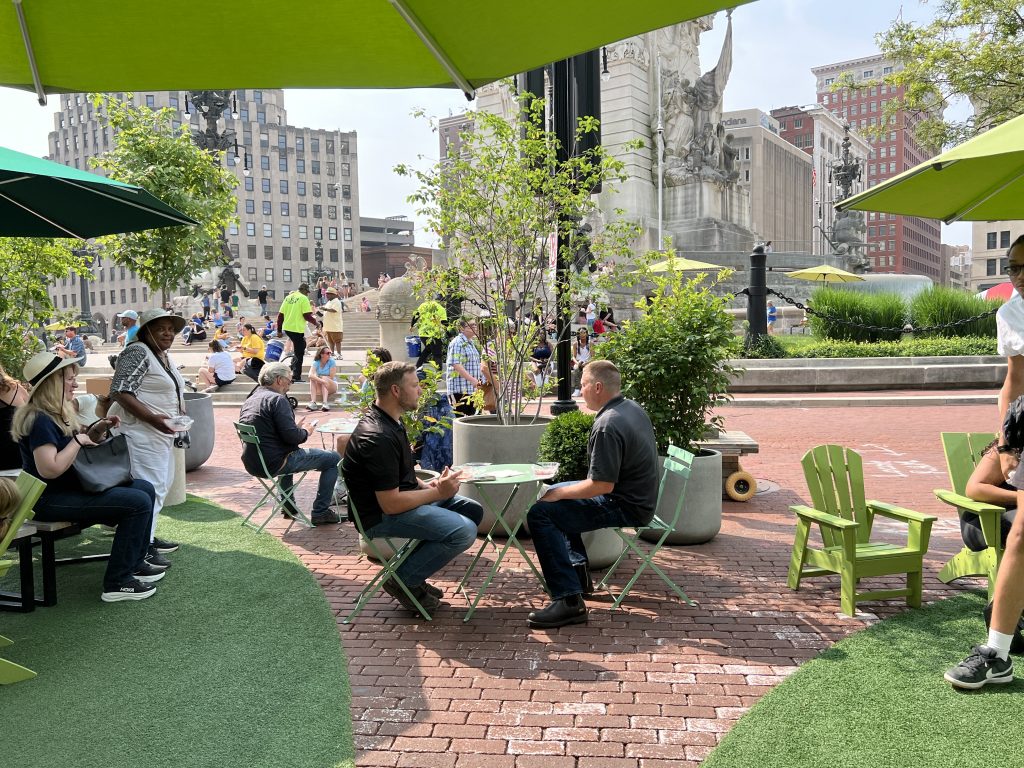
Big Car’s team of staff artists, working in design, writing, performance, and more, builds a framework in the circle’s expanse that is treated as both canvas and stage. Objects, seating, and interventions are placed not for decoration but as everyday props that spark interaction. From a ping pong table to lunchtime poetry, to a procession, to a making workshop, SPARK shifts art’s focus from the object — what is made — to the encounter — what happens between people.
Big Car’s authorship is visible in this structuring. The choices of what to install, who to invite, and how to pace the unfolding of the program are aesthetic decisions. Just as a curator arranges artworks in a gallery, Big Car arranges conditions for people to encounter one another differently in public space. This is not accidental conviviality. It is a designed and durational art practice, steeped in reflexivity, artistic judgment, and collaborative authorship.
Claiming Place in the Canon
Social practice art (put very simply, creative work where the process of people coming together is the art) has often been under-recognized in comparison to architecture or design when it operates in public space. The architect of a plaza may be celebrated, while the artist who activates, nurtures and evolves its use is overlooked. SPARK challenges this imbalance by demonstrating that curating social life is itself an art form, no less rigorous than sculpture or painting.
In the lineage of socially engaged art in the States, SPARK belongs alongside projects such as Allan Kaprow’s 1960s “happenings” where audiences became the artwork and Suzanne Lacy’s “new genre public art” in the 1980s and ‘90s, where artists worked directly with communities on issues that mattered to them. This is seen also with Rick Lowe’s Project Row Houses in Houston and Theaster Gates’ Rebuild Foundation in Chicago.
SPARK’s contribution is distinctive. It reimagines a civic monument not through permanent alteration but through temporary inhabitation. The monument remains unchanged in stone, but profoundly altered in meaning as people experience it as a place of play, dialogue, and co-creation. It resonates with American philosopher and educator John Dewey’s idea of “art as experience,” where meaning is made in doing, and where everyday life is reframed through creative encounters.
I first experienced SPARK in its opening year, 2015, when I was in Indianapolis researching Big Car’s practice for my PhD. I spent days at Monument Circle, observing how a civic landmark was reshaped through everyday encounters. What I saw was not a temporary festival but a carefully curated artwork that treated public life itself as material. Since then, I have followed Big Car’s work closely, writing about SPARK in Arts in Place (2017) and keeping in touch with the organization as it has evolved. This long view allows me to see SPARK not just as a series of seasonal programs, but as a sustained contribution to the international conversation on socially engaged art.
Social Benefit Through Artistic Means
SPARK is not an isolated festival but part of Big Car’s long trajectory of socially engaged work across Indianapolis. The collaborative has cultivated a deliberate aesthetic strategy that invites participation and, in the process, leaves people seeing both themselves and each other differently.
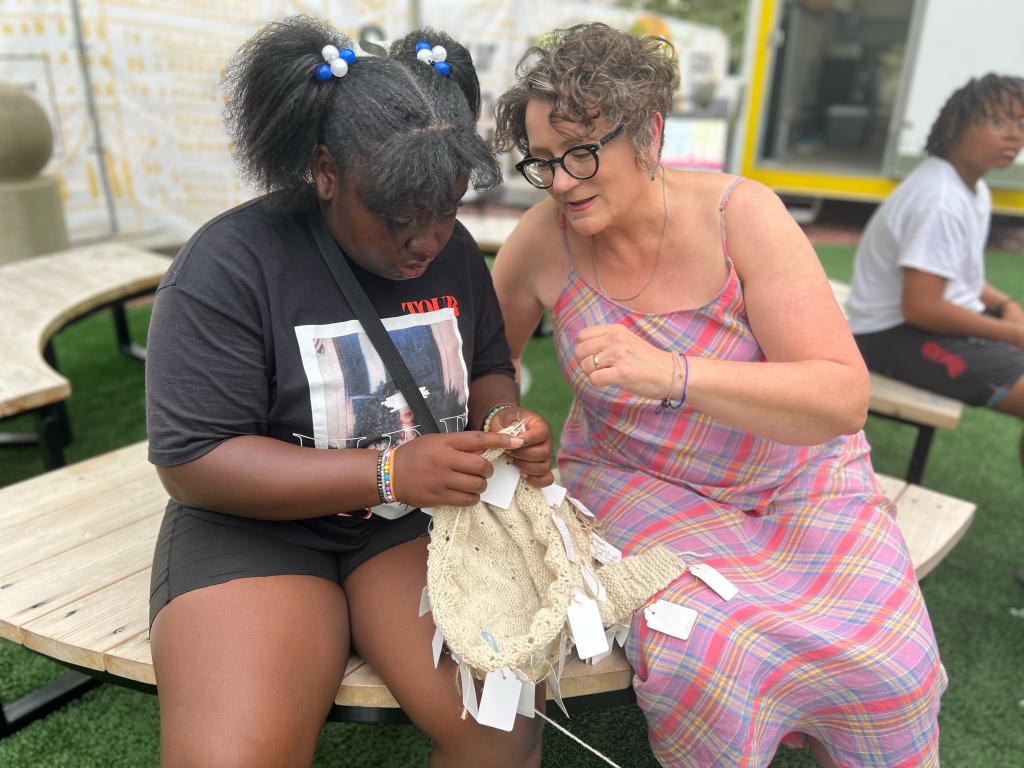
Big Car’s ethos is that even brief engagement can be transformative. A passer-by who joins in painting or conversation may, in that moment, see themselves differently: I am an artist today. Yet too — participants do not need to name their actions as art to benefit from them. What matters is that the process is conceived and held by artists, who use aesthetic tools to generate access, reduce barriers, and open civic dialogue.
SPARK reshapes how people imagine their role in public life and how they relate to their city long after the moment has passed. This authorship matters. Without Big Car’s framing, SPARK would be simply a civic amenity. With it, SPARK is part of the canon of socially engaged art, offering both social benefit and artistic innovation.
As socially engaged art has matured internationally, it has faced the risk of being absorbed into policy jargon or reduced to instrumental outcomes. SPARK resists this by remaining rooted in artistic process. It is art first, even as it delivers civic and social benefits. Its success lies in holding these together, and in doing so it has helped shape new understandings of what art in public space can be.

Looking Forward
Ten years on, SPARK still reimagines the Circle. Each season it remakes the familiar into something alive: a monument that becomes a meeting place, a plaza that becomes a playground, a civic space that becomes a stage. In both the US and the UK, public spaces have become increasingly contested, with rising polarisation, social isolation, and pressures on civic life.
Against this backdrop, SPARK matters all the more. It models a different possibility: people sharing space without barriers, talking to strangers, and seeing themselves as part of a larger whole. These encounters may seem modest, but they are acts of civic imagination. They suggest that another kind of public culture is possible, one based not on division, but on participation and care.
In a cultural landscape that can overlook the value of socially engaged art, SPARK is proof of its power. It does not monumentalize form; it monumentalizes encounter. And in doing so, it secures its place in the canon of socially engaged art — not as footnote, but as exemplar.
Dr. Cara Courage is a culture, communities, and place consultant, and placemaking practitioner, writer, and broadcaster. Her PhD research (2014–2017) focused on Big Car, the Indianapolis-based socially engaged art and placemaking organisation with which she has continued to collaborate and research ever since. She is Editor-Convenor of the Routledge Handbook of Placemaking (2021) and Co-Editor-Convenor of Trauma-Informed Placemaking (Routledge, 2024).